Categories
Uncategorized

A REPLY TO CLLR PAUL MESSENGER

Response to Cllr Paul Messenger from Save Our NHS in Kent (re Stroke review plans in Kent)

Paul Messenger (PM): I am genuine in my worries that mis info is being put out there possibly scaring badly some elderly Thanet residents that they will ‘die in ambulances’

SONiK: If you had attended any of the listening events in Thanet, you’d know that many elderly people are quite capable of making up their own minds on this, and they will attend these meeting and make very intelligent points. They are angry about this, and possibly they are scared of ‘dying in an ambulance’, but they are certainly not scared of standing up in a hall full of people and putting pertinent questions to the panel.

PM: I’m quite prepared to work with anyone who approaches an issue in a calm evidence based way.

SONiK: Our website site is full of evidence-based responses to the case put by Kent and Medway STP. Have you read any of our briefings or articles?

PM: It is fact that Hyper Stroke units are superior to existing ‘normal ‘ provisions. It is also fact that SECAmb can deliver patients to WH well under the hour. It is fact that the prescribed clinical advice for ‘call to needle’ is 120 mins.

SONiK: None of the things you quote above are unequivocal facts.

PM: I have had meetings with QEQM staff and James Pavey, Head of operations SECAmb so I’ve done the leg work – and none I repeat none of those shouting and screaming outside the QEQM have even bothered to seek the evidence.

SONiK: That is incorrect. A number of us in SONIK (Save Our NHS in Kent) attended the full presentation (a 3 hour meeting) at County Hall in Maidstone on January 31st where the entire plan was laid out in detail. We have seen all the evidence that the Kent & Medway STP provide, including reading the 151 page document in all its detail. Then we gathered a team of volunteer researchers who have scrutinised the evidence, and found some of it wanting. In addition to that, we have sought out studies that contradict the points made by the STP. We also have a number of doctors in our group who have been working on this with us, and they agree that there are many problems with the arguments made in the stroke review plan. Have you scrutinised the consultation materials at all? Or have you just allowed people on the STP to give you a quick briefing, and then taken all they say as ‘fact’? As an elected representative I really hope you put a little bit more effort in than that.

PM: My only interest is the welfare of Thanet residents not to scare them to bits just to further what is a national ‘underfunding’ agenda you lot are forever campaigning for.

SONiK: I think you are grossly misunderstanding the mood of people here in Thanet. I have spoken to so many people about this issue in Ramsgate, and none of them need any prompting in their reaction to this plan – it is very rare that you meet someone who thinks that being taken to Ashford in an emergency situation with a time sensitive and very serious condition like stroke is a good idea. When this was proposed in London, it was stipulated in the plans that all patients must be able to reach a HASU (Hyper Acute Stroke Unit) within 30 minutes. In South Yorkshire, it was stipulated that all patients must be able to reach a HASU within the ‘critical time’ of 45 minutes. And now in Thanet, we are told an hour will be alright.

PM: We are very lucky to have a fantastic hospital for Thanet and the staff work incredibly hard there for us. And to look out their windows on a weekly basis and see demonstration after demonstration inferring the service is not up to scratch must be so demoralising for them.

SONiK: The staff at QEQM hospital are demoralised by the consultation materials and videos that imply people are left waiting for 3 hours in A&E when they have a stroke. We know from people on the ground that patients go straight through to the stroke unit. Also, QEQM rates higher than the national average for rapid diagnosis of strokes, and higher than most hospitals in Kent. It is indeed a good hospital.

PM: So yes I’ll work with you if you drop the banners, cut out the megaphones, and realise that all health matters are apolitical.

SONiK: Are you calling on those 400 or so people who gathered on Feb 24th to stop protesting? Protests are a legitimate way to draw attention to an issue within a democracy: I don’t see why you have a problem with that. If we hadn’t protested we wouldn’t have the amount of members that we now do; we wouldn’t be able to draw people together around this very serious issue. As a councillor who represents us at county level, I don’t think it is very inappropriate of you to place conditions such as ‘drop the banners’ on whether or not you will ‘work with’ members of the public. You are obliged to work with all members of the public. You say ‘all health matters are apolitical’ – where did you get that idea? The NHS will always be political as long as it’s paid for with taxpayers’ money. When people pay their NI contributions and then find they’re getting a raw deal, they will make their concerns felt, and you should not seek to quash that response.

Carly Jeffrey

Save Our NHS in Kent

Categories
Uncategorized

REPORT: Listening Event 26 Feb

A summary of the Listening Event at Margate Football Club, Kent and Medway stroke Review, 26th Feb 2018.

People arrived and seated themselves at round tables facing the panel at the front of the room. Each table had one facilitator from the Kent and Medway STP (Sustainability and Transformation Partnership, the group of NHS executives who created the stroke review plan) seated amongst the audience members. There was a brief presentation, followed by an open Q&A session, which went as follows:

It was argued by various audience members at length that three HASUs (Hyper Acute Stroke Units) are not enough, that it must be possible to find enough consultants to staff at least one extra unit, and that the distance to Ashford is not safe for emergency treatment. The panel’s responses to this relied heavily on the argument that workforce shortages are the reason why there can only be three stroke units for all of Kent in their plan, despite the geographical size of the area.

Members of the public referred to the FAST initiative, the golden hour, the need to be seen as quickly as possible, and the journey time being over an hour from Thanet to Ashford.

People commented that this was not a true consultation for the people of Thanet and East Kent, as there is in fact no choice; this area has been presented with one option only, the questionnaire does not allow people here to reflect their need for the best quality stroke care at QEQM, as that option was taken off the table before the consultation began.

Another person asserted that the option for East Kent (Ashford) is not really even in East Kent, it is in mid Kent.

These were the questions that were not properly answered, causing the audience to become agitated and call for clear answers:
– This plan means a reduction in the number of acute beds, how is this an ‘improvement’?
– Is it possible to train nurses to administer thrombolysis and then we could have more HASUs (Hyper Acute Stroke Units) rather than just 3 for the whole of Kent?
– Will you confirm that the STP (the NHS executive body who designed the stroke review) is committed to saving £457m from Kent’s NHS budget by 2020?

One questioner talked about difficulties getting to Ashford without a car on a weekend, and described her two options when she had to take her sick daughter from Cliftonville to William Harvey Hospital in Ashford; her choices were either a £70 taxi both ways, or a journey over 2 hours each way with two train journeys, lots of walking and a bus journey. She didn’t feel her daughter could cope with the public transport option, so she had to pay a large sum for 2 cabs; as a low income earner, she felt this was not acceptable.

Also raised was this question regarding potential privatisation: “Will the new stroke units be put out to tender?” This was one area where panel were willing to give clear answers, and the answer was ‘no’ to this. They were also asked “Will you be following the London model which includes ambulance transfers in the payments made to the stroke providers?”, and the panel answered that SECamb will continue to provide the service, and that SECamb will continue to use private providers to cover some of their service, as they do currently.

There was much frustration from the public due to what appeared to be evasion from the panel. The chair was also attempting to avoid certain questioners because they had already asked a question; this and the chair’s decision to call and end to open Q&A while there were still many questions to be asked spilled over into disruption of the meeting, in the form of people standing up to show that they wanted the Q&A to continue. This action was led by a member of SONIK. A good portion of the room were standing, maybe two thirds of the audience, if you exclude the facilitators sitting at each table. After that, the meeting broke down as many people left to get home in the snowy weather, and a few stayed to take part in the facilitated round table groups. The chairperson was quoted after the meeting as saying he’d been given a set structure and timings to follow, and that everyone should be limited to one question unless the timings allowed a second “go” round.

It’s safe to say that the panel from Kent and Medway STP did not manage to reassure or persuade the audience on this occasion; Save Our NHS in Kent will be attending or getting reports from future meetings where possible.

THE PANEL:
Dr Tony Martin (Head of Thanet Clinical Commissioning Group and Manager of Bethesda GP Surgery)
Dr David Hargroves (Clinical Lead for Stroke in East Kent)
Caroline Selkirk (Accountable Officer for Medway CCG)
James Pavey (Regional Operations Delivery, South East Coast Ambulances East)
Susan Acott (Chief Executive,  Dartford and Gravesham NHS Trust, interim CEO, EKHUFT)

Categories
Uncategorized

STROKE CONSULTATION BRIEFING

By Steve Wilkins – briefing for people going to a Listening Event.

THE case that is being made to centralise stroke services into just 3 Hyper Acute Stroke Units (HASUs) in Kent & Medway is that this will benefit people who have strokes because they will receive greater intensive treatment, faster with a dedicated multi-disciplinary team of specialists for up to 72 hours followed by up to 15 days in a co-located Acute Stroke Unit (ASU). This, it is claimed, will reduce the number of deaths from stroke and long term permanent disability, and that this outweighs the impact of the additional time it will take some people to get to the HASU.

When someone has the symptoms of a stroke, time is of the essence to minimise the damage. The patient needs to be scanned as soon as possible to decide whether this is the result of blood clot or a brain bleed because the treatments are very different. Most strokes are the result of clots and in these cases an assessment needs to be made as to whether the patient would benefit from a clot busting drug. This only applies to 10 -20% of cases but for these people the administration of the clot busting drug, a process called Thrombolysis, needs to take place as early as possible to ensure the best outcome.

While we accept that stroke services are currently poor in some parts of Kent and that the HASUs deliver benefits for people with stroke symptoms we do not agree that the distances and time it will take some people to reach a HASU are acceptable so we are proposing a different model (see below) to achieve better outcomes for everybody.

We believe that the model being proposed is also linked to another agenda, the establishment of just 3 hospitals delivering full A&E and specialist services with the consequent downgrading of the remaining hospitals as part of the Sustainability & Transformation Plan (STP) hospital re-configuration.

We already know that William Harvey Hospital in Ashford is the planned A&E and specialist services for East Kent and it is the only East Kent hospital being offered as a HASU in all 5 options being put out to consultation. Despite the fact that consultation on the full STP is due to start in April there has been no indication so far of what is being planned for hospital re-configuration in the rest of Kent. It seems very likely that whichever other 2 hospitals get the HASUs will also be the remaining 2 A&E and specialist services hospitals. Losing stroke services in some hospitals on the promise of better treatment in HASUs provokes much less widespread hostility than announcement that they are facing more general downgrading. Once HASUs are established however they can be used to justify the wider agenda.

The London Model

The model for HASUs in Kent & Medway is based on the model that operates in London that reduced the number of deaths from stroke by 100 and also reduced the length of time people stayed in hospital. However there are some major differences between London and Kent. The number of HASUs is decided on population figures not geographical area so London with a larger and more dense population has 8 HASUs whereas Kent is proposing just 3.

The London HASUs were set up so that everyone would be within 30 minutes or less of a HASU, in Kent it is one hour or less. London Ambulance Service figures show that the average travel time to HASUs is just 16 minutes. This is a world away from the situation in Kent where people have to travel longer distances, and it is some of the most deprived parts of Kent where stroke incidence is at its highest people will potentially have to travel furthest.

The Kent proposal admits that for a small number of people it may take more that hour and many people in Thanet for instance say that it takes more than an hour to get to William Harvey Hospital in Ashford. In mitigation Stroke Consultant Dr Hargroves has suggested that Ambulances could be fitted with video links to the HASUs so that some of the preliminary assessments can be done while in transit to reduce the time between arrival at hospital and treatment. In the US and Germany there are trials taking place fitting Ambulances with CT scanners and small laboratories so that all the necessary tests can take place while patients are being transported to hospital, but this is not being proposed here in Kent & Medway now or any time in the foreseeable future.

The best outcomes for people with stroke occur when they receive intensive treatment within 3 hours of the onset of the symptoms. There first needs to be a recognition of the symptoms which are not always obvious, a call for an Ambulance, the Ambulance to arrive, assess the patient and get them in the Ambulance, then travel to hospital for treatment. The target is then (hospital) ‘door to needle time’ of 30 minutes or less. Clearly the longer time people have to travel the less chance they have of receiving treatment within 3 hours.

The much shorter journey times may well account for the reduced number of deaths in London. There are currently no figures available that show what improvement is possible in an area more comparable to Kent.

There are also other potential explanations for the improved figures in London as admitted in the Kent & Medway Pre-Consultation Business Case which states:

It is not clear that the London model can be transferred to a more rural environment or how effective the centralised model would be outside urban areas (Hunter 2013, Morris 2014) if the populations and stroke types differed. Nor was it clear that the period from 2010-12 in London was typical, though all models seem to have been well tested for the sensitivity of their assumptions. London had made relatively less progress than the rest of England in the period leading up to reconfiguration of its stroke services; so did the gains in London just represent a catching up? When asked to adopt the London model, hospital managers in the Netherlands reacted by claiming that the reconfiguration in London has only managed to lift low levels of care to match the care quality already present in the Netherlands (Monitor Evidence Report 2014). *i.

Another key difference from the London model is that instead of 3 ASUs co-located with the 3 HASUs as is being proposed for Kent, London’s ASUs are located in 24 hospitals so that stroke patients are returned to a hospital close to their home after the intensive 72 hours in one of the HASUs. This also means that 24 hospitals retain all the additional services required to support ASUs which again raises the suspicion that the proposal to centralise stroke services in Kent is being used as cover to downgrade hospitals not designated as an HASU.

Will HASUs Reduce Long Term Disabilty?

In the presentation of the Pre-Consultation Business Case at the end January Dr Hargroves made much more of reducing long term disability than reducing deaths but again there are no figures that show how much, if any, disability is reduced by the centralisation of stroke units into HASUs. It is assumed that the reduction in length of stay in hospital is an indicator of reduced disability but equally crucial is what happens after people are discharged into the community for rehabilitation and aftercare. We know from the Community Health Re-Provisioning meeting in December that whereas the Stroke Units are dedicated specialist teams providing intensive treatment, in the Community the opposite is going to be the case, where specialists are going to be ‘upskilled’ into generalists which also means fewer people covering more jobs. It was reported at the last Medway Trades Union Council meeting that this had already occurred in at least one part of Kent.

Reduction in Beds

Although the figures are confusing because there is an inclusion of people from Bexley and a part of Sussex who would have to travel to a HASU in Kent there is a clear reduction in the number of stroke beds as part of this proposal. If you exclude beds currently outside of Kent the number of stroke beds we have now is 144. This will be reduced to anything between 127 and 98 depending on which of the 5 options is chosen.*ii

Finance

While the overall aim of the STP is to save money, the HASUs are going to cost £40m.This is similar to the cost of setting up 8 HASUs in London of £43m. This money is not coming from the NHS itself but is going to be borrowed externally. As we know from the disastrous PFI deals this is potentially going to lock the Kent & Medway NHS into large re-payments lasting for 20 years. Stroke care has changed profoundly over the last 10 years and is likely to change again over the next 10 years so we could be left paying for a model years after it has been superseded by newer models and techniques.

It is also something of a mystery as to why the NHS is prepared to spend so much on stroke services where the improvement in mortality is only 1.1%. That doesn’t seem very cost effective. We of course welcome any improvement in mortality and reduction in disability. I take the view that whatever money is necessary to improve people’s health and wellbeing should be found. Nevertheless, there are many other serious potentially fatal and debilitating illnesses and conditions that are not getting such lavish treatment.

Our Model

The overarching priority for people showing symptoms of a stroke is to get scanned and treated as early as possible and the best results occur when this happens within 3 hours of the symptoms first occurring. The most time critical elements are scanning and where appropriate, thrombolysis. We believe that the additional travelling time of up to 1 hour or more, particularly for people in areas of deprivation and higher stroke incidence can be overcome by a slightly different model.

1. Patients showing symptoms of stroke are transported as quickly as possible to their nearest hospital whether or not it is a HASU.

2. Patients are scanned on arrival at that hospital via a video link to a stroke consultant at a HASU where the hospital is not a HASU.

3. The Consultant decides on the most appropriate treatment for that patient and thrombolysis is administered by suitably trained staff if appropriate.

4. Patients are then transported to the HASU for 72 hours for intensive monitoring and treatment from the specialist stroke team before being returned to an ASU at their local hospital.

This model takes account of the lack of specialist stroke staff, particularly Stroke Consultants where there is currently a 40% national vacancy rate. Video links to static hospitals are simpler than video links to ambulances on the move and most importantly it means that stroke patients are seen and treated in the shortest possible time. Locating ASUs in local hospitals where patients will stay up to 15 days also makes it easier for patients and their families to see each other regularly at a time of great anxiety and stress.

*i.  https://kentandmedway.nhs.uk/wp-content/uploads/2018/01/Appendix-G-Evidence-Review-of-Hyperacute-Stroke-Units.pdf p21

*ii.  https://kentandmedway.nhs.uk/wp-content/uploads/2018/01/180124-Stroke-PCBC-vFINAL.pdf p36

https://kentandmedway.nhs.uk/wp-content/uploads/2018/01/Appendix-L-Bed-and-capacity-modelling.pdf p12 onwards
Categories
Uncategorized

Margate Constutaltion ‘a shambles’

Press Release
February 2018

CONSULTATION PROCESS IS “A SHAMBLES”

The consultation process over stroke treatment in east Kent is now an “absolute shambles,” according to the Save Our NHS In Kent (SONIK) group.

Their verdict followed the breakdown of a meeting held by local NHS bosses last night (26th Feb) at Margate Football Club.

A panel of high ranking local NHS officials, including Dr Tony Martin, Head of Thanet’s Clinical Commissioning Group, and Dr David Hargroves of  East Kent Hospitals University NHS Foundation Trust, presented proposals which will mean the closure of the stroke unit in Margate hospital and Thanet stroke victims having to travel to Ashford.

“Everyone knows that good treatment for stroke patients depends on how fast you can be treated,” said a SONIK spokesperson. “This plan means the chances of survival for Thanet stroke victims will be severely reduced.”

According to SONIK,  the meeting started to break down because of a refusal of many in the audience to accept answers provided by the panel.

The SONIK spokesperson said: “Members of the public often just did not believe what the NHS people were telling them, things like that there weren’t enough trained staff to provide a stroke service in Margate.”

But the meeting finally fell to pieces, according to SONIK, when the organisers tried to force the audience to split into round table discussions.

The SONIK spokesperson said: “Splitting into round table groups would mean that people would have to discuss questions set out by the organisers. But most of the audience wanted to go on asking questions of the panel refused to split into groups.”

According to SONIK, the meeting then started to fall apart, with around three quarters of the audience deciding to leave rather than take part in round table discussions.

A spokesperson for the SONIK group said: “The refusal of the NHS representatives to go on answering questions from the public shows what a fake and hollow process this consultation is.”

The spokesperson added: “We believe the whole local NHS consultation process is a sham and a shambles. We are calling on the NHS authorities to abandon their present format for public consultations and instead hold proper public meetings where people can quiz officials and have a vote at the end.”

“Most importantly, we must have an option on the table which allows us to have a stroke unit at Margate hospital.”

There are two more consultation meetings now scheduled in the Thanet area. For more information visit saveourNHSkent.org.uk

Editors for background, pictures etc, ring 07989070843.

Categories
Uncategorized

Rotherham Stroke Campaign

Save our local hospital emergency stroke services

We need your support to help fund a legal challenge to the decision to close our emergency stroke services in both Barnsley and Rotherham local hospitals.

Both Barnsley Save Our NHS and Rotherham Save Our NHS campaign groups are seeking to raise funds to support this challenge to the closure of the emergency stroke services at both our local hospitals here in South Yorkshire.

Our industrial heritage contributes to a much higher incidence of stroke in both our towns than the national average for England.

The emergency stroke service is known as the Hyper Acute Stroke service and helps you during the first 72 hours after having a stroke.   It is the service that provides treatment, which if given early enough, can help recovery and prevent long term disabilities.

The Barnsley resident, and both campaign groups, are concerned that the views of local people in Barnsley, and in Rotherham, were not taken account of by the decision-makers, and that the people in these two towns were not treated fairly.

The case is challenging the decision made by the Joint Committee of Clinical Commissioning Groups (JCCCG) at their meeting held on 15th November 2017 to close the emergency stroke services at Barnsley and Rotherham hospitals.

The challenge is on the following grounds:

  • The JCCG has failed to ensure all relevant information was obtained in order to make an informed decision.
  • The JCCCG is proceeding to implement the proposed changes without the Joint Health Scrutiny Committee having the opportunity to consider the Decision Making Business Case and propose recommendations.
  • Reliance on the consultation in relation to the changes is not rational given the change in circumstances since the consultation was carried out.
  • Where the JCCCG has taken into account the consultation it failed to take into account the product of The consultation with the majority of views being against the proposals.
  • The JCCCG is making emergency stroke services further away from people’s own communities for patients from Barnsley and Rotherham which fails to comply with Article 25 of the UN Convention on the rights of people with disabilities

To further explain some points:

An example of information that was not obtained to inform the decision was about transport concerns that families in Barnsley and Rotherham raised.  It was about needing to use public transport, to visit a relative in a specialist stroke unit many miles away, which will involve long journeys and many changes.

At the JCCCG meeting in April 2017, the decision-makers acknowledged these concerns and agreed to do further work on these transport issues.

However, this work was not carried out.

Instead public transport concerns were dismissed by a statement in the Equality Impact Assessment attached to the Decision Making Business Case approved by the November meeting of the JCCCG. This statement says:

The potential social impact in relation to travel for visitors has already been considered and is minimal.”

An example of a change in circumstances since the consultation and before the decision was made, concerns information clearly given in the consultation document.

The consultation took place in the winter of 2016/17 winter and the consultation document said that it was only emergency stroke services that were changing and that the stroke units would remain. There was an independent report published in March 2017 analysing the consultation responses, which were made based on the information given at the time.

However three months later, in the summer of 2017, the new South Yorkshire and Bassetlaw Accountable Care System decided to review the sustainability of five hospital services across the area, one of which is non-emergency stroke units.

The Decision Making Business Case that the JCCCG decided to approve and to fund, in November 2017, clearly implies that Barnsley and Rotherham Stroke Units may not now be sustainable.  This is not the information we were consulted on when we were told, in October 2016, that these services were safe and were definitely not going to be closed.

Categories
Uncategorized

Thanet North Labour Party back SONiK and 24th protest

*** LATEST: Broadstairs Labour Party has also adopted the SONiK resolution***

••• Margate West, Birchington and Villages branch has backed this too •••

The following resolution was passed at a meeting of Thanet North Labour Party this week. Other party groups and organisations are welcome to back us too. We are not a party political group but welcome support and backing.

Save Our NHS in Kent RESOLUTION

The North Thanet Constituency Labour Party notes:

The NHS is under-funded, understaffed and struggling to cope with increasing demand. The Government is aiming to cut another £22bn from the NHS by 2020, nearly a fifth of the entire NHS budget. They intend to achieve this through Sustainability and Transformation Plans (STP).

STPs involve a major reorganisation of the NHS from top to bottom. Under the 2012 Health & Social Care Act any new or reorganised health service must be put out to tender, so most services could be run by private providers in the next 3-4 years.

In east Kent we already know part of the proposed plan is to:
• Reduce the number of GP surgeries. In the whole of Thanet, there will be as few as three, for example. • Services closed last year at Kent & Canterbury Hospital (without consultation) will stay closed.

• Stroke care for the whole of East Kent will be in a Hyper-Acute Stroke Unit (HASU) located in Ashford (Mid-Kent). Current services in Margate and Canterbury will close. Journey times from the coastal towns – with high levels of poor health and deprivation – could lead to death and disability due to late treatment.

The Save Our NHS in Kent (SONiK) group are organising with others a protest outside Margate QEQM Hospital at noon on 24 February 2018. The protest is to stop removal of stroke services from east Kent and for the delivery of a HASU at the hospital.

This CLP believes:

• The millions of pounds being cut from Kent’s NHS budget through the STP should be halted and reversed. The STP should be halted. Proper provision should be made for all NHS services.

• Stroke services in Kent and Medway have become a post-code lottery. Thanet QEQM needs a Hyper-Acute Stroke Unit (HASU).

• We must defend the NHS as a publicly funded, publicly run health service, free at the point of deliv- ery. Social Care should be run on a similar basis. Privatisation has no place in the NHS.

This CLP resolves:

• To back the SONiK protest on 24 February. To encourage members to attend and aim to send a banner to the protest.

• To support Thanet Trades Council’s ‘NHS Day’ planned for Saturday 5 May, in Margate. • To donate the sum of £ * to SONiK to help towards the cost of the campaign.

* please note that the funds for SONiK are held in trust by Thanet TUC and cheques should be made payable to: Thanet TUC. SONiK c/o 11 Grosvenor Road, Broadstairs, Kent, CT10 2BT

Please email and let know how whether the motion was agreed saveourNHSkent@gmail.com

Categories
Uncategorized

REPORT: street stalls

Margate on Saturday: pop-up street stall

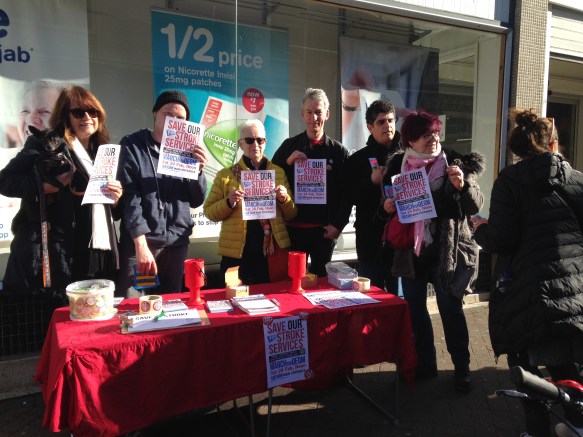
On Friday and Saturday last week, members of SONiK ran two fantastically successful stalls promoting the Save Our Stroke Services protest on 24 February at QEQM. We had queues of people wanting to sign our petition. We ran out of petitions really quickly and a fast thinking member managed to get one of the local banks to photocopy more for us!

Over 600 signatures were collected, adding to over 1100 already gathered online. Hundreds of leaflets were given out. People took posters, fliers and petitions to give out at work and encourage people to sign up to the campaign.

On Saturday in Margate, we were joined by campaigning Labour Cllr. Ian Venables, as well as new people who we had never seen before.

We have never had such a positive response before. The cutting of our stroke services it a hot issue, which affects everyone. People are rightly angry about the possible loss of services. We heard many stories from stroke survivors who said they would not be alive today if they’d had to travel to Ashford for treatment.

In addition to the stalls, we have leafleted shops, pubs, cafes and also undertaken door to door leafleting in some areas. We have distributed over 6000 leaflets so far.

We are planning to hold a stall this Friday 23 February at 11am, Ramsgate High Street. Please join us.
Categories
Uncategorized

Ten things YOU can do…

If you support our campaign, here’s 10 things you can do to help…

WHAT YOU CAN DO

1. Sign our two petitions!  Change Our Stroke Service at QEQM Hospital and Halt the Undemocratic Pseudo-Consultation

2. Come to our protest on Saturday Feb 24th (12 noon, QEQM main entrance). Bring as many people with you as you can.

3. Attend the listening events (public meetings arranged in order for locals to have their say). Speak up, ask questions, voice your concerns. Dates: Thanet events are on 7th March and 26th Feb – the full list of meetings across Kent is here: https://kentandmedway.nhs.uk/stroke-consultation-listening-events/

4. Fill in the consultation questionnaire – be wary, it is not designed to allow opposing views! Use the free text boxes at the end. https://kentandmedway.nhs.uk/stoke-consultation-questionnaire/

5. It’s important to email your opinions as well, as the parameters of the questionnaire are too limiting. Email your point of view using this address km.stroke@nhs.net and mark it for the attention of Steph Hood and Patricia Davies.

6. Spread the word. Talk to friends and family. Remember, this is at the consultation stage now, so the stroke unit closure will happen if there’s not a sizeable objection from the public. It’s crucial to act now.

7. You can complain (km.stroke@nhs.net) if you feel that that consultation documents look more like an advert for the new system than an impartial document. Both sides should be presented, and any potential closures or loss of services must be clearly stated.

8. Write a letter to your local news outlets, call up local radio, write to your MP. Ask your local councillors why they are not doing anything about this (if they aren’t already).

9. Look out for any adverts promoting the plan, especially if you see an online ad that appears to be misleading. Take a screenshot/clipping/photo and send it to saveournhskent@gmail.com

10. Watch this space for more info and updates! www.saveournhskent.wordpress.com  Facebook: Save Our NHS Kent  saveournhskent@gmail.com

Categories
Uncategorized

Trade Union Support

Model resolution of support

Save Our NHS in Kent MODEL RESOLUTION

This branch / committee / group notes:

The NHS is under-funded, understaffed and struggling to cope with increasing demand. The Govern- ment is aiming to cut another £22bn from the NHS by 2020, nearly a fifth of the entire NHS budget. They intend to achieve this through Sustainability and Transformation Plans (STP).

STPs involve a major reorganisation of the NHS from top to bottom. Under the 2012 Health & Social Care Act any new or reorganised health service must be put out to tender, so most services could be run by private providers in the next 3-4 years.

In east Kent we already know part of the plan is to:
• Reduce the number of GP surgeries. In the whole of Thanet, there will be just three, for example. • Services closed last year at Kent & Canterbury Hospital (without consultation) will stay closed.

• Stroke care for the whole of East Kent will be in a Hyper-Acute Stroke Unit (HASU) located in Ash- ford (Mid-Kent). Current services in Margate and Canterbury will close. Journey times from the coastal towns – with high levels of poor health and deprivation – could lead to death and disability due to late treatment.

The Save Our NHS in Kent (SONiK) group are organising with others a protest outside Margate QEQM Hospital at noon on 24 February 2018. The protest is to stop removal of stroke services from east Kent and for the delivery of a HASU at the hospital.

This branch / committee / group believes:

• The millions of pounds being cut from Kent’s NHS budget through the STP should be halted and reversed. The STP should be halted. Proper provision should be made for all NHS services.

• Stroke services in Kent and Medway have become a post-code lottery. Thanet QEQM needs a Hyper-Acute Stroke Unit (HASU).

• We must defend the NHS as a publicly funded, publicly run health service, free at the point of deliv- ery. Social Care should be run on a similar basis. Privatisation has no place in the NHS.

This branch / committee / resolves:

• To back the SONiK protest on 24 February. To encourage members to attend and aim to send a ban- ner to the protest.

• To support Thanet Trades Council’s ‘NHS Day’ planned for Saturday 5 May, in Margate. • To donate the sum of £ * to SONiK to help towards the cost of the campaign.

* please note that the funds for SONiK are held in trust by Thanet TUC and cheques should be made payable to: Thanet TUC. SONiK c/o 11 Grosvenor Road, Broadstairs, Kent, CT10 2BT

Please email and let know how whether the motion was agreed saveourNHSkent@gmail.com